PC(USA) Minute for Mission ~ World AIDS Day

The Presbyterian Mission Yearbook for Prayer and Study dates back to 1892 and has the longest history of any denominational mission and prayer book in the United States.

Today’s PC(USA) Minute for Mission from the Mission Yearbook…
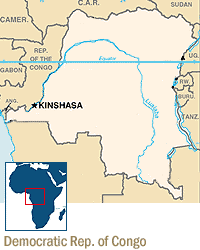
Map of CongoOne of the many ways that God multiplies the loaves is through partnership. PC(USA) partner the Presbyterian Community of Congo (CPC) is addressing the needs of children orphaned by HIV and AIDS in the Democratic Republic of the CongoUNICEF estimates that as of 2009 more than 16 million children under 18 have lost one or both of their parents to AIDS. Ninety-three percent of these orphans live in sub-Saharan Africa. Despite these overwhelming statistics, significant progress is being made.

Trained volunteers from the Action Presbyterienne Contre la SIDA (APCS), the AIDS program of the CPC, work to address the needs of the many orphans in the area. To help carry out this work, the APCS created in many of the local communities charity committees responsible for visitation. The volunteers visit the families who take care of the orphans (sometimes relatives, sometimes not), encourage them, and assess their physical and emotional well-being. The volunteers also work with the local parish to identify ways to assist the orphan(s) and the host family by providing food, clothing, money for school support, etc.

The APCS has found that the most effective way of caring for an orphan is to encourage and support the whole family. When the family is healthy, all the members thrive.

—Joy Raatz, former facilitator, HIV/AIDS Initiative
PC(USA) 1001 Worshiping Communities ~ Kairos Church

1001 Worshiping Communities is movement happening in the Presbyterian Church (USA). Across the PC(USA), God is raising up leaders in churches and presbyteries who are creating new worshiping communities. They are taking on new and varied forms of church for our changing culture. Primarily they are seeking to make and form new disciples of Jesus Christ, to change and transform the world.

Today’s Spotlight Community – Kairos Church
Kairos Church is one of 22 new worshiping communities in Atlanta, Georgia.  See how devotion to scripture, intimate fellowship, prayer and extravagant generosity are creating God given moments and growth for Kairos Church.

Learn about this and many, many, many more exciting new worshiping communities of the PC(USA) at www.onethousandone.org

“The Holy Spirit is on the move. It’s an exciting time to be Presbyterian.” ~ Bill Golderer, 2013 PC(USA) Moderators Conference

Trinity, let’s stay PC(USA)

Leaving Room For Reformation

Presbyterians have been debating whether its ordained officers should be required to adhere, or subscribe, to a certain set of tenets or beliefs since its earliest days in America.  Initially it was the Westminster Standards in the 18th and 19th centuries and later the famous “five points” in the early 20th century.

Today, once again, there is great concern by those advocating a split from the PC(USA) that the denomination does not specifically name its essential tenets.  David S Kennedy, editor of The Presbyterian published an editorial titled “The Present Conflict”, in which he wrote the battle shaping up between conservatives and liberals is “the renewal of the old primitive conflict between cultured heathenism and historic Christianity.”  He wrote this in 1911.  It’s like deja vu all over again, and again.

In the PC(USA) service for ordination we ask those to be ordained, “Do you sincerely receive and adopt the essential tenets of the Reformed faith as expressed in the confessions of our church as authentic and reliable expositions of what Scripture leads us to believe and do, and will you be instructed and led by those confessions as you lead the people of God?”

ECO’s service for ordination asks those to be ordained, “Will you receive, adopt, and be bound by the Essential Tenets of ECO as a reliable exposition of what Scripture teaches us to do and to believe, and will you be guided by them in your life and ministry?

Clearly there is a difference between receiving and adopting the essential tenets of the Reformed faith as expressed in the Book of Confessions and receiving, adopting and being bound by the Essential Tenets of ECO.

Of course the concern is that without the moorings of specifically defined essential tenets the denomination will drift theologically.  But we’ve drifted before, to better places (we’ve drifted past restricting women from leadership and slavery as two examples).  What certainly looked like drift to some at the time, we now see as a push by the Holy Spirit.  Why would we want to tie ourselves down so tightly now?

In the early 20th century when the Fundamentalist-Modernist controversy was threatening to tear some denominations apart, Trinity’s own denomination at the time, The United Presbyterian Church of North America, chose not to tie itself to the five points of Fundamentalism.

  1. The inerrancy of the Bible
  2. The virgin birth of Christ
  3. His substitutionary atonement
  4. Christ’s bodily resurrection
  5. The authenticity of miracles

Our predecessor denomination was in agreement that these five doctrines in question were true and should be believed, but they were unwilling to claim them as essential tenets of the Christian faith upon which salvation depended.

At the time of the controversy Dr. W. E. McCulloch published an editorial in The United Presbyterian titled, “What are the Christian Fundamentals?” His sentiment was typical of the United Presbyterian Church during this period.  Dr. McCulloch maintained everyone should make up his own list of “fundamentals” to see just where their own faith stands.  He submitted his own list as follows:

  1. The Fatherhood of God
  2. Salvation through Jesus Christ
  3. God’s abiding presence in and through the Holy Spirit
  4. God’s judgement of rational beings and Christ’s return
  5. Eternal life with God

I think it is fair to say a part of Trinity’s DNA includes the resistance of being tied to a specific set of essential tenets.  

Trinity, let’s stay PC(USA) 

PC(USA) Minute for Mission ~ Christ the King

The Presbyterian Mission Yearbook for Prayer and Study dates back to 1892 and has the longest history of any denominational mission and prayer book in the United States.

Today’s PC(USA) Minute for Mission from the Mission Yearbook…

W hat can you do?” muttered the grief-stricken teenage son of a heart-attack victim during the dark morning hours at a community hospital. Having only been a hospital chaplain for a few weeks, I had no answer for him. Instead, I offered what I could: “I could pray with you or call your spiritual leader?” He shook his head and turned back into the dim room where his mother and siblings were.

I sat down at the nurse’s station, feeling completely helpless. I was only a student chaplain, there to fulfill a requirement for ordination. Yet somehow here I was: the chaplain to a grieving family; helpless.

It is easy to keep those who sit in darkness at arm’s length, whether they are grieving the loss of a loved one, drowning in debt, or dealing with abusive relationships. We can sit next to them and have no idea how dark their shadows are. That night I could no longer keep those sitting in darkness at arm’s length, and I saw with new clarity how that person was me. I and this family sat in death’s shadow that night—the death of a loved one and the death of the self-reliant me.

The reign of Christ is no longer an abstract concept for me. In Luke 1:78–79, we are reminded that even in the midst of the deepest darkness God will bring the dawn and somehow guide our lives and world into the way of peace. Christ’s reign can be embodied in us each time we act on the prayer “Thy will be done.” It is not our helplessness that makes us weak but our unwillingness to be the body of Christ for the world.

I was not helpless that night, but I had made a mistake. My mistake was thinking that what the family needed was me.

—Emily Hope Morgan, author of the blog Fight the Bees!

PC(USA) 1001 Worshiping Communities ~ The Upper Room

1001 Worshiping Communities is movement happening in the Presbyterian Church (USA). Across the PC(USA), God is raising up leaders in churches and presbyteries who are creating new worshiping communities. They are taking on new and varied forms of church for our changing culture. Primarily they are seeking to make and form new disciples of Jesus Christ, to change and transform the world.

Today’s Spotlight Community – The Upper Room
The Upper Room gathers in a diverse neighborhood in Pittsburgh. To pray, share communion, be touched by the Holy Spirit. Like the early disciples,who met in The Upper Room, they see gospel love changing lives.

Learn about this and many, many, many more exciting new worshiping communities of the PC(USA) at www.onethousandone.org

“The Holy Spirit is on the move. It’s an exciting time to be Presbyterian.” ~ Bill Golderer, 2013 PC(USA) Moderators Conference

Trinity, let’s stay PC(USA)

We’re Free To Dismantle The Walls Anytime We Want

I discovered this sermon by The Reverend Dr. Craig Barnes, President of Princeton Theological Seminary on the Presbytery of Los Ranchos’ “discern” blog.  Give yourself 17 1/2 minutes to watch the entire sermon.  It’s beautiful, it’s winsome and it will draw you closer to Christ Jesus.

The sermon is most powerful in its whole but here are the closing words…

“All things hold together in the center that is Christ Jesus.  All of it, it all holds.  Our lives hold not by building walls around them that will protect us from evil.  The Church holds not by its exterior walls, because as he (Paul) says in verse 14 (Ephesians, chapter 2) these walls only divide us.  They only create hostility…These walls only divide and they are completely unnecessary to the Church because the Church holds by its center.  If you define the Church at the center you don’t have to worry about the walls any more.  You can give up worrying about who’s in and who’s out of the Church.  We have no business talking about these boundary issues any more of who’s in or who’s out.  Your life will hold together by the center, the God who dwells with us, Jesus Christ.  The Church will hold by its one center, Jesus Christ.  We’re free to dismantle the walls anytime we want.”

Our leadership at Trinity is making it clear that Trinity is not becoming narrower in its theology if we move to ECO.

A set of “Frequently Asked Questions” issued by the leadership and dated May 18, 2013 says, “Trinity continues to affirm the essential tenets of the Reformed faith spelled out in our Confessions and Creeds.  The session also continues to affirm the Confessing Church principles which the session adopted in 2001 and reaffirmed in 2004 and 2006.  The three principles are: ‘Jesus Christ alone is Lord of all and the only way of salvation; Holy Scripture is the triune God’s revealed Word, the Church’s only infallible rule of faith and life; and that God’s people are called to holiness in all aspects of life.  This includes honoring the sanctity of marriage between a man and a woman, the only relationship within which sexual activity is appropriate.'”

In the congregational meeting a couple weeks ago we were told again Trinity is not “narrowing its positions, it’s clarifying them.”

I agree that being dismissed from the PC(USA) and joining ECO will not change or narrow these positions at Trinity, but, it will do more than clarify them.  It will build a wall around them.

If we define the Church by the center we don’t have to worry about the walls anymore.  

Trinity, let’s stay PC(USA)

An Authority of Scripture Higher Than Our Walls

The PC(USA)’s view of the authority of scripture is being called into question by our leadership at Trinity.  Their accusation is the PC(USA) gives higher authority to culture than to the written word of God, and as a result the denomination is moving in a direction against God’s will.  

I understand how it can look like this but it’s not true.  One of the hallmarks of Reformed Theology which the leadership at Trinity seems to be overlooking, is theology as wisdom.  Word and Spirit were the basic and essential factors in John Calvin’s interpretation of Scripture and in his theology.  Today the PC(USA) and Reformed Christians still submit to the authority of the written word of God as illumined by the Holy Spirit of God.  We don’t submit to the written word of God as defined by a set of clearly defined essential tenets. 

The Confession of 1967, in the Presbyterian Church (USA)’s Book of Confessions states,

“The one sufficient revelation of God is Jesus Christ, the Word of God incarnate, to whom the Holy Spirit bears unique and authoritative witness through the Holy Scriptures, which are received and obeyed as the word of God written. The Scriptures are not a witness among others, but the witness without parallel…The Bible is to be interpreted in the light of its witness to God’s work of reconciliation in Christ. The Scriptures, given under the guidance of the Holy Spirit, are nevertheless the words of men, conditioned by the language, thought forms, and literary fashions of the places and times at which they were written. They reflect views of life, history, and the cosmos which were then current. The church, therefore, has an obligation to approach the Scriptures with literary and historical understanding. As God has spoken his word in diverse cultural situations, the church is confident that he will continue to speak through the Scriptures in a changing world and in every form of human culture.  God’s word is spoken to his church today where the Scriptures are faithfully preached and attentively read in dependence on the illumination of the Holy Spirit and with readiness to receive their truth and direction.”

Paul Rack, interim pastor of Hope Presbyterian Church in Tinton Falls, NJ and Stated Clerk of Elizabeth Presbytery writes a very thoughtful defense of the PC(USA) in his blog Raxweblog.  Regarding biblical authority and interpretation he writes, “The case may be made that the PC(USA) is being far more responsive to the movement of the Holy Spirit than churches retreating into doctrinal shelters hermetically sealing them away from the present world.”  I agree.

So why is Trinity’s leadership working to protect their understanding of biblical authority with a set of defined essential tenets?

Peter Enns has written an article titled, “Tim Keller on Homosexuality and Biblical Authority: Different Crisis, Same Problem.”  It has helped me see the road block our leadership faces in a clear light.  I recommend the entire article to you but want to quote one section in particular.

“Keller is right. To change their views on homosexuality will require evangelicals to ‘disassemble the way in which they read the Bible, completely disassemble their whole approach to authority’…Leaving aside the specific issue of homosexuality, Keller’s observation about evangelical notions of biblical authority is correct but also concerning. In my opinion, Keller has, perhaps unwittingly, put his finger on the entire problem evangelicals face when confronted with any issue that runs counter to evangelical theology: ‘You’re asking me to read my Bible differently than my tradition has prescribed, and so I can’t go there. If I do, my faith is kicked out the door.'”  

Walls are essential when your authority of scripture is based on the written word of God as prescribed by your tradition, but not when it is based on the written word of God illumined by the Holy Spirit.

The promise of our baptism is we have been grafted to the body of Christ and the power of the Holy Spirit has been poured out on us, that we might have the power to do God’s will, and continue forever in the risen life of Christ.

Trinity, let’s stay PC(USA)


PC(USA) Minute for Mission – Presbyterian Frontier Fellowship

The Presbyterian Mission Yearbook for Prayer and Study dates back to 1892 and has the longest history of any denominational mission and prayer book in the United States.

Today’s PC(USA) Minute for Mission from the Mission Yearbook…

Pres Frontier Fellowship

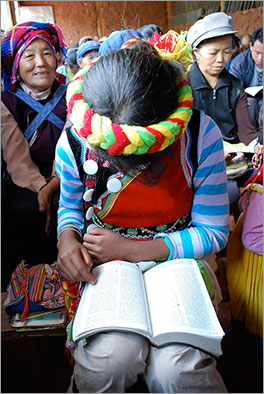
Many thousands of Muslims have become followers of Jesus in a movement in Southeast Asia the last few years. Among other things, they are multiplying their loaves in an intriguing way with respect to Bible translation.

This group of new disciples has not had a Bible translation that reflects their language and culture, so they have been creating their own with consultants from the United Bible Societies. As portions of Scripture are translated, they are used by leaders of the movement to teach and disciple regional leaders. Whenever people have problems understanding the text, that information is given to the translators so they can rethink the translation. The result is that the translation process is also the discipling process!

Last year Presbyterian Frontier Fellowship received some undesignated funds for frontier mission work. We contacted our liaison to this movement to see if there was a need that we could help meet. We received the following response:

“This is an answer to prayer!’ Our director was with the movement’s leader in that area of the world when he got the message; they had just prayed because of a need in the translation department that had not yet been met. He was so excited to hear this for many reasons. One, of course, because of the provision for the need. The other—and maybe the more important one in the director’s eyes—because it was a direct answer from out of the blue to the prayer they had just prayed! This boosted the faith of our fellow believers in Jesus in that area!”

—Rev. Bill Young, executive director, Presbyterian Frontier Fellowship

PC(USA) 1001 Worshiping Communities ~ The Journey

1001 Worshiping Communities is movement happening in the Presbyterian Church (USA). Across the PC(USA), God is raising up leaders in churches and presbyteries who are creating new worshiping communities. They are taking on new and varied forms of church for our changing culture. Primarily they are seeking to make and form new disciples of Jesus Christ, to change and transform the world.

Today’s Spotlight Worshiping Community – The Journey
“The Journey” is appealing to students’ intellect and faith with a “question couch” and a lot of faith on one of the most unreached campuses for Christianity in South Carolina.

Learn about this and many, many, many more exciting new worshiping communities of the PC(USA) at www.onethousandone.org

“The Holy Spirit is on the move. It’s an exciting time to be Presbyterian.” ~ Bill Golderer, 2013 PC(USA) Moderators Conference

Trinity, let’s stay PC(USA)

I Am With You Always

Trinity’s leadership is rushing to build a moat and walls around its theological belief system as fast as possible.  To hear them talk there is a fast approaching attack, reasons to be afraid, and we must defend ourselves, our faith, and the Church.  Dismissal and separation from PC(USA) will dig the moat and a defined list of Essential Tenets will build the wall.  If we can get inside this fortress soon enough everything will be ok.  

But I am not afraid of what is coming, and neither are many others of us at Trinity.  We’ve been told we just don’t “get it”.  But I do “get it” and I think others do too.  We just “get it” differently and because of that we’re not afraid.

Peter Enns, a faculty member in the Christian Studies department at Eastern University, has written a column titled, “The Bible is the center of the Christian faith (and don’t assume you know what I mean by that)“.  In this column he writes about a lecture given recently at Eastern University by John Franke of Yellowstone Theological Institute.  John summed up his vision for a theological movement that is both evangelical and progressive by voicing a distinction between progressive (think center) and traditionalist evangelicalism (think walls).

Progressive evangelical theology is…

1)  marked by holding to a “center” of theology rather than maintaining firm “boundaries”

2) views the theological task as more of a “dialogue” than arriving at firm conclusions defended at all costs

3) and encourages a deliberate engagement of voices outside of evangelicalism in order to learn from them, not simply to correct them

Peter writes, “Firm boundary marking, once and for all time, in our theological quest tends toward insulation and then isolation from any sort of criticism – which I think is not only self-defeating and intellectually hypocritical, but makes baby Jesus cry.”

Peter continues, “A theology that thinks in terms of holding to a center encourages theological exploration, with regular returns to the center for a gut check…It seems to me that one way (not the only way) of thinking about the Bible is as a ‘center’ of the Christian faith rather than a boundary.  It is that to which followers of Jesus return – sort of like a tether – not the thick and high boarders through which we may not blast, under which we may not tunnel, or over which we may not climb.”

Building the walls around Trinity scares me more than living without them.

Peter is not saying, and neither am I, that the Bible is “THE center” of the Christian faith but, he writes, “it helps provide a spacial metaphor for understanding how the Bible can and should function in the Christian life.  The center of the Christian faith has been and always will be – wait for it – Jesus, not the Bible.”

Matthew 28:16
…and lo, I am with you always, to the close of the age.

Trinity, let’s stay PC(USA)