We’re Better Together

I believe all of us at Trinity, and in the PC(USA), are trying to be faithful to God and the Bible as best we know how. But we have to admit we don’t all view God, the Bible and human experience the same, which cuts to the core of why Trinity’s session has requested that the presbytery dismiss our congregation from the PC(USA) ~ theological drift.

It’s helpful to understand how the leadership at Trinity views the Bible.

The Rev. Tim Fearer presented a series of classes at Trinity in February/March 2013 titled “Trinity Distinctives” where he used a continuum of views of the Bible to illustrate where Trinity’s leadership falls.  You can see Tim’s entire presentation, including a full explanation of the different views of the Bible, here (the continuum of views starts 37 minutes into the video).

Trinity’s staff and elders identified themselves on the continuum as inerrant, infallible and neo-orthodox at their retreat in early 2013, although Tim tends to think the leadership is more inerrant and infallible than neo-orthodox in their views (think fundamentalist and conservative/traditional – using terms from yesterday’s post).

This assessment of how our leadership views the Bible is not exact, but it helps frame the situation we find ourselves in.  If what Tom Trinidad says in his blog Thinking Faith is correct, that by and large the congregations seeking dismissal from the PCUSA are conservative/traditional to fundamentalist in their approach, then our session’s request for dismissal is not out of character with other like-minded congregations.

Clearly our session has concerns with staying in the PC(USA), but there are real concerns we need to have about leaving.

First, one of the freedoms and blessings of the PC(USA) is the denomination makes room for its leaders to exercise “freedom of conscience”, captive only to scripture, as it is interpreted according to the essentials of the Reformed faith and polity expressed in our constitution.

The PC(USA) believes the Holy Spirit works within an individual’s “freedom of conscience” and collectively, as a church, we believe the discernment of these individuals is most clear in the larger bodies (sessions/presbyteries/General Assembly).  Currently the General Assembly, the largest body of the denomination, is moving in a direction our session believes is contrary to scripture.  I think we have to be very cautious about asking for dismissal when we disagree with the collective discernment of the larger body.

Second, our different views about God and the Bible keep each of our theologies more true.  This is a view shared by Jerry Deck, a self described evangelical and past executive director of Presbyterian Global Fellowship, in an opinion column titled “Liberal Conservative or Conservative Liberal?“, published in the Presbyterian Outlook dated June 25, 2012.

Jerry writes, “For the most part I feel this denomination (the PC(USA)) has given me that opportunity in ways that few others ever could, and for this I am incredibly grateful…the reality is that as a Christian community we are in peril if we lose one of our “ends” which hold us in tension. All too often when this tension is lost, we are left with a community that looks less like Christ and more like ourselves.”

I recommend the entire column to you.

Trinity, let’s stay PC(USA) where it’s better we’re not all like-minded.
In the Beginning…

The Rev. Dr. Tom Trinidad is the Vice Moderator of the 220th General Assembly (2012) of the Presbyterian Church (U.S.A.) and pastor of Faith Presbyterian Church in Colorado Springs, CO.

I want to introduce you to Tom’s blog Thinking Faith and an entry titled “Explaining Faith Church and the Presbyterian Church USA“.  Tom does an excellent job presenting four basic approaches to viewing God, the Bible and human experience and explains all four approaches can be found in the PC(USA) but that our official theology is in the middle, characterized by both progressive and conservative/traditional approaches.

Tom explains the four approaches below.  I’ve applied an example of how Christians who believe God created the heavens and earth reconcile the differences between the six day creation story in Genesis 1 and modern science using each approach.

Fundamentalist dismiss human experience as a source of knowledge and rely solely on the Bible.  Creation happened in a literal six days, there is no possibility science is correct.

Conservatives/Traditionalist take human experience into consideration as a source of knowledge, but it is subordinate to biblical revelation. Where the two conflict, the Bible decides.  Creation happened in a literal six days, but there is a possibility science is correct.

Progressives consider human experience as well as the Bible as sources of knowledge, while at the same time recognizing that God as Mystery transcends the Bible. Where there are conflicts, progressives err on the side of grace, trusting God to be the judge.  Science is correct, but there is a possibility creation happened in a literal six days.

Liberals look to human experience as the final arbiter of conflicts among sources of knowledge.  Science is correct, there is no possibility creation happened in a literal six days.

I tend to stand between the two middle ground approaches.  @beardonabike posted this tweet on Twitter yesterday, “There is a difference between leaning on your own understanding and throwing away God given critical thinking skills.”  I agree.  I believe the PC(USA) does too.

How do you view God, the Bible and human experience?

PC(USA) Minute for Mission – Caregiver Sunday

The Presbyterian Mission Yearbook for Prayer and Study dates back to 1892 and has the longest history of any denominational mission and prayer book in the United States.

Today’s PC(USA) Minute for Mission from the Mission Yearbook…

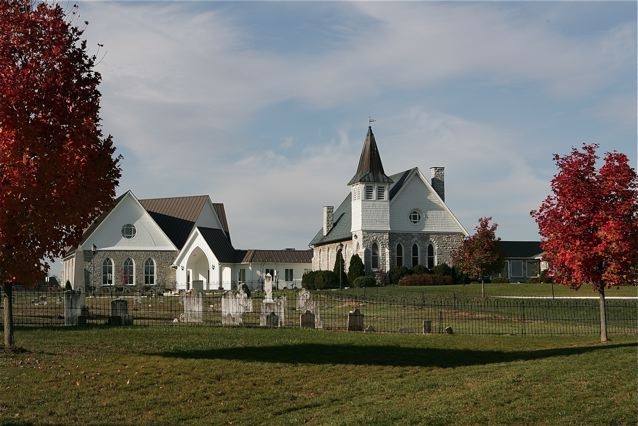
Opequon Presbyterian Church

Opequon Presbyterian Church (OPC) in Winchester, Virginia, has a long record of caring. People began worshiping here in 1732. Its tradition of caring has been securely passed down for 275 years!

My husband and I came to OPC after a move for his work. Not long after our arrival, we both had serious health issues. We now believe that it was not the job but God that brought us here, placing us where we could be cared for in an extraordinary way. OPC walks alongside us like we have been here all 275 years! Their tradition of caring extends not only to us but to many others who pass this way.

Tuesday Morning Mission folks gather for prayer and to prepare meals for those who need encouragement. Intercessory prayer partners pray for other members so that the whole congregation is covered with prayer throughout the year. A bear ministry sends out teddy bears carrying the message of God’s love to those who need that reminder. Scrapbookers create cards for the card ministry. Birthday prayers are sent to each member. The Hands and Hearts group creates prayer gifts to go with Tuesday Morning meals and pastoral visits. There are also prayer-shawl, parish-nurse, and bereavement ministries. The Shepherd’s Touch team trains volunteers who are paired with members going through rough times. A community garden yields food for another congregation’s food pantry. Care is offered in ways unknown. The tradition continues!

—Rev. Donna B. Coffman, R.N., minister-at-large, Presbytery of Shenandoah

Let’s Find A Better Way

My voice is advocating for staying in the PC(USA) but I move forward with this blog in the same spirit of open conversation, trust and transparency approved by the Presbytery of Los Ranchos.

The motion approved by the Presbytery of Los Ranchos on September 20, 2012

We, the Presbytery of Los Ranchos,

  • Authorize the Strategic Coordinating Team to develop initial recommendations for a process and guidelines for discernment of the heart of our congregations and our Presbytery in this time. These recommendations will be brought to Presbytery at the November 2012 meeting. The process will address how to equip congregations and the Presbytery:
  • To define and actively pursue our missional purpose
  • To develop theological clarity on the issues that both inspire and challenge our ministry together
  • To explore and define the nature of our connectionalism and ecumenical cooperation in new ways
  • To explore and clarify the purpose of presbytery in this new environment
  • To suggest ways that congregations can discern their call, including the possibilities of reaffirming their commitment to the PC(USA) or seeking alignment with other denominations.
  • Affirm that congregations and pastors in the Presbytery of Los Ranchos are encouraged to have these open conversations within and among themselves on all issues without fear of negative repercussions as we want to cultivate trust through transparency.

Update and recommendations from the Strategic Coordinating Team presented to Presbytery at the November 2012 meeting (see pages 4924 and following)

Welcome to Trinity #StayPCUSA

Trinity #StayPCUSA is my voice advocating for staying in the Presbyterian Church (USA).  It is primarily addressed to Trinity United Presbyterian Church in Santa Ana, CA where I am a member but it is also addressed to anyone looking for more information as they discern their own future within our denomination.

In PC(USA) congregations where the session is recommending dismissal from the denomination those of us who believe otherwise can be left feeling alone and disconnected.  We are not alone though, it can just be hard to find each other.

Blogs like this, Twitter and other social media can help us connect across the denomination but also with members in our own congregations.  I encourage Twitter users to hashtag #StayPCUSA and to post your own thoughts or links to helpful resources.  There may be thunder but the sky is not falling in the PC(USA).

While I am sorting through ideas and outlining blog posts to come please visit the ABOUT page as well as the different RESOURCE pages available on this blog.

If you’re looking for a place to start let me offer two suggestions.  The first is a presentation made by our Presbytery Pastor Steve Yamaguchi to Trinity titled Is the PCUSA Burning Down?.  The video is short and gets right to he heart of some of the most troubling concerns being raised about the PC(USA).  If you have more time I also recommend Dr. Jerry Andrews’ scholarly video, Essential Tenets.  Dr. Andrews graciously articulates both the evangelical desire for clearly defined essential tenets as well as his own commitment to staying in the PC(USA).  These are great places to start.

Eric Christiansen